
In shortResort work remains an option in Japan in 2026, including seasonal hotel positions with staff accommodation. Whether an offer works for you depends on the duties, dates, language requirements and living arrangements. A headline about a labour shortage cannot answer those questions.
Quick guide
| Check | What to know |
|---|---|
| Start with your circumstances | When reviewing the evidence, we found three different measures often discussed together: visitor demand, employers' staffing difficulties and the number of people who actually take jobs. They describe different parts of the market. This guide separates them, then shows how to compare an offer before moving. |
| If you already live in Japan, start with what would change | A move to a resort is also a change of home, routine and support network. Before choosing a destination, write down what you would leave behind: a current job, an apartment, a partner's schedule, a regular medical appointment or a Japanese class. Decide which of those you need to keep. |
| What the market numbers can tell you | |
| Staffing pressure has eased in part of the hotel sector | Teikoku Databank's April 2026 survey put the share of hotel and ryokan businesses reporting a shortage of non-regular staff at 38.5%. The corresponding April figures were 63.8% in 2024 and 51.8% in 2025. This is a proportion of surveyed businesses, not a vacancy rate. TDB: April 2026 survey. |
| Tourism demand does not guarantee a full schedule | Japan Tourism Agency's preliminary July 2026 result recorded 54.67 million guest nights nationwide, down 3.5% year on year. The agency also notes that a change in survey stratification from January 2026 may affect annual comparisons. Japan Tourism Agency: July release. |
| Resort employment is established, but available applicants are harder to count | In its August 13 announcement about the year ended June 2026, Dive's official investor-relations account reported 11.8% annual sales growth for its tourism HR business. This is newer than the company's third-quarter information. It is a business growth measure, not an increase in the number of jobseekers. Dive: full-year announcement. |
| Examples of advertised winter 2026–27 roles | |
| Original budgeting exercise: hours can matter more than the headline rate | Suppose the hourly rate is ¥1,800. At twenty paid hours a week for four weeks, gross pay is ¥144,000. At forty hours it is ¥288,000. The difference is ¥144,000 even though the hourly rate is identical. |
| Work out the cash you need before your first payday | Monthly affordability and arrival cash are separate questions. A job may cover your usual expenses once pay begins while still requiring money that you do not have available on moving day. Ask for the payroll closing date and the first payment date, then work backwards from those dates. |
| Translate your language ability into real tasks | Recruiters need to understand what you can do at work. Instead of relying only on labels such as “basic Japanese” or “fluent English,” give an example of a task you can handle and an example where you would need support. |
| Conditions and workplace support matter to workers | A survey of 529 Okinawa tourism workers, conducted in October–November 2025 and published in January 2026, found that 75.0% rated workplace relationships as very important when choosing an industry or employer; 71.1% gave that rating to pay and bonuses. It was not a survey solely of foreign residents or seasonal workers. Okinawa Convention & Visitors Bureau. |
| Questions to send before accepting an offer | |
| Use this sequence before committing to the move | |
| A ready-to-adapt message for an employer | Subject: Winter 2026–27 role — availability and accommodation questions |
| Plan the end of the season while choosing the beginning | Put four dates on one line: your last shift, your last permitted night in staff housing, your final payday and the date you can enter your next home. They may not coincide. Ask about each one before treating the season as a complete financial plan. |
| Prepare your conditions, then take the next step | Resort employment in 2026 has both current recruitment examples and evidence of people taking work. Your task is to find the arrangement that fits your dates, skills and living budget. |
Start with your circumstances
When reviewing the evidence, we found three different measures often discussed together: visitor demand, employers' staffing difficulties and the number of people who actually take jobs. They describe different parts of the market. This guide separates them, then shows how to compare an offer before moving.
Our sources were checked by September 20, 2026. The article is written for people considering resort employment, particularly foreign residents already in Japan. It does not estimate your chance of being hired.
For a quick decision: look for a role you can perform, dates you can commit to, confirmed accommodation and a budget that still works with fewer paid hours. Then check the written offer against those conditions. The practical sections below explain how to do that while you are already living in Japan.
If you already live in Japan, start with what would change
A move to a resort is also a change of home, routine and support network. Before choosing a destination, write down what you would leave behind: a current job, an apartment, a partner's schedule, a regular medical appointment or a Japanese class. Decide which of those you need to keep.
For example, imagine that your current apartment will remain available for one month after you start the resort job. You would need to budget for that overlap even if the staff room looks inexpensive. If you need to return to your current city regularly, include the journeys in your comparison. A housing benefit is easier to assess when you know the expenses it actually replaces.
Prepare a short availability statement: “I currently live in [city]. I can arrive on [date] and work until [date]. I need accommodation from [date].” Add your relevant skills and the tasks for which you would need training. This is more useful to a recruiter than simply saying that you are already in Japan.
You do not need to settle every moving detail before applying. You do need to know which conditions would make an offer impossible to accept. Put those conditions at the top of your notes so they are discussed early.
What the market numbers can tell you
| Measure | Useful for understanding | Does not establish |
|---|---|---|
| Overnight stays | Use of accommodation services | Vacancies or applicants |
| Employers reporting shortages | Perceived staffing pressure | The number or type of unfilled jobs |
| A staffing company's placements | Employment arranged through that business | Total jobseekers across Japan |
| A current employer advertisement | A specific role and its published terms | Your hiring probability or guaranteed availability |
Use these sources together. None provides a complete count of resort employers and eligible applicants seeking the same dates and location.
Staffing pressure has eased in part of the hotel sector
Teikoku Databank's April 2026 survey put the share of hotel and ryokan businesses reporting a shortage of non-regular staff at 38.5%. The corresponding April figures were 63.8% in 2024 and 51.8% in 2025. This is a proportion of surveyed businesses, not a vacancy rate. TDB: April 2026 survey.
The later July survey reported a 28.8% shortage share for non-regular staff across all industries. It is not a hotel-specific update to the April figure, so the two percentages should not be used as a hotel-sector trend. TDB: July 2026 survey.
For an applicant, the useful next question is what the employer needs someone to do. Guest calls, room cleaning, restaurant service and driving require different abilities. Ask which tasks you would perform during your first month and which ones you would handle independently. A vacancy can exist without being suitable for your experience or availability.
Tourism demand does not guarantee a full schedule
Japan Tourism Agency's preliminary July 2026 result recorded 54.67 million guest nights nationwide, down 3.5% year on year. The agency also notes that a change in survey stratification from January 2026 may affect annual comparisons. Japan Tourism Agency: July release.
That national summer result does not predict winter employment in Hakuba or Niseko. It does, however, give a reason to avoid budgeting on the assumption that tourism and working hours will automatically keep rising.
Ask about quieter weeks as well as peak periods. Find out whether advertised weekly hours are indicative or guaranteed in the contract. Check training days, the opening weeks and the end of the season. A budget that only works during the busiest week needs another source of financial flexibility.
Resort employment is established, but available applicants are harder to count
In its August 13 announcement about the year ended June 2026, Dive's official investor-relations account reported 11.8% annual sales growth for its tourism HR business. This is newer than the company's third-quarter information. It is a business growth measure, not an increase in the number of jobseekers. Dive: full-year announcement.
A separate company release reported 14,555 people taking work through Dive in the year ended June 2025, up 24.3%. That historical company figure demonstrates actual employment activity; it does not count people currently available to join a new employer. Dive: employment figures.
The sources we reviewed do not establish how many foreign residents are ready to move to a particular resort this winter and can perform a particular role. Nationality, residence, work permissions, language ability and willingness to relocate are different characteristics. From your side, stating precise availability and relevant experience helps an employer understand whether there is a match.
Examples of advertised winter 2026–27 roles
| Employer | Published terms | Information to confirm |
|---|---|---|
| Setsu Niseko, seasonal front desk | November 13–March 31; ¥1,600–¥1,850/hour; 30–40 hours/week; subsidized accommodation; business-level or native English, conversational Japanese helpful | Housing charges, guaranteed hours and assigned tasks |
| The Hakuba Collection, guest host | December–March; ¥1,800/hour; approximately 20–40 hours/week; private room at ¥30,000/month including utilities; driving credential required | Japanese requirements, licence suitability and housing dates |
Sources: Setsu Niseko recruitment and The Hakuba Collection recruitment. These are examples, not a pay survey or an employer ranking. Confirm the current offer directly before booking travel.
The examples show that seasonal accommodation-linked work and English-focused guest service are being advertised. They do not show that every applicant will obtain a room, secure those hours or meet the employer's requirements.
Original budgeting exercise: hours can matter more than the headline rate
Suppose the hourly rate is ¥1,800. At twenty paid hours a week for four weeks, gross pay is ¥144,000. At forty hours it is ¥288,000. The difference is ¥144,000 even though the hourly rate is identical.
| Hypothetical four-week budget | Case A | Case B |
|---|---|---|
| Paid hours per week | 20 | 40 |
| Gross pay | ¥144,000 | ¥288,000 |
| Assumed housing allocation | ¥30,000 | ¥30,000 |
| Gross pay minus housing only | ¥114,000 | ¥258,000 |
This editorial exercise does not predict earnings from either advertised job. Four weeks is not a calendar month. Taxes, insurance, food and travel are excluded, as are any overtime or late-night premiums. The final row is not take-home pay or savings.
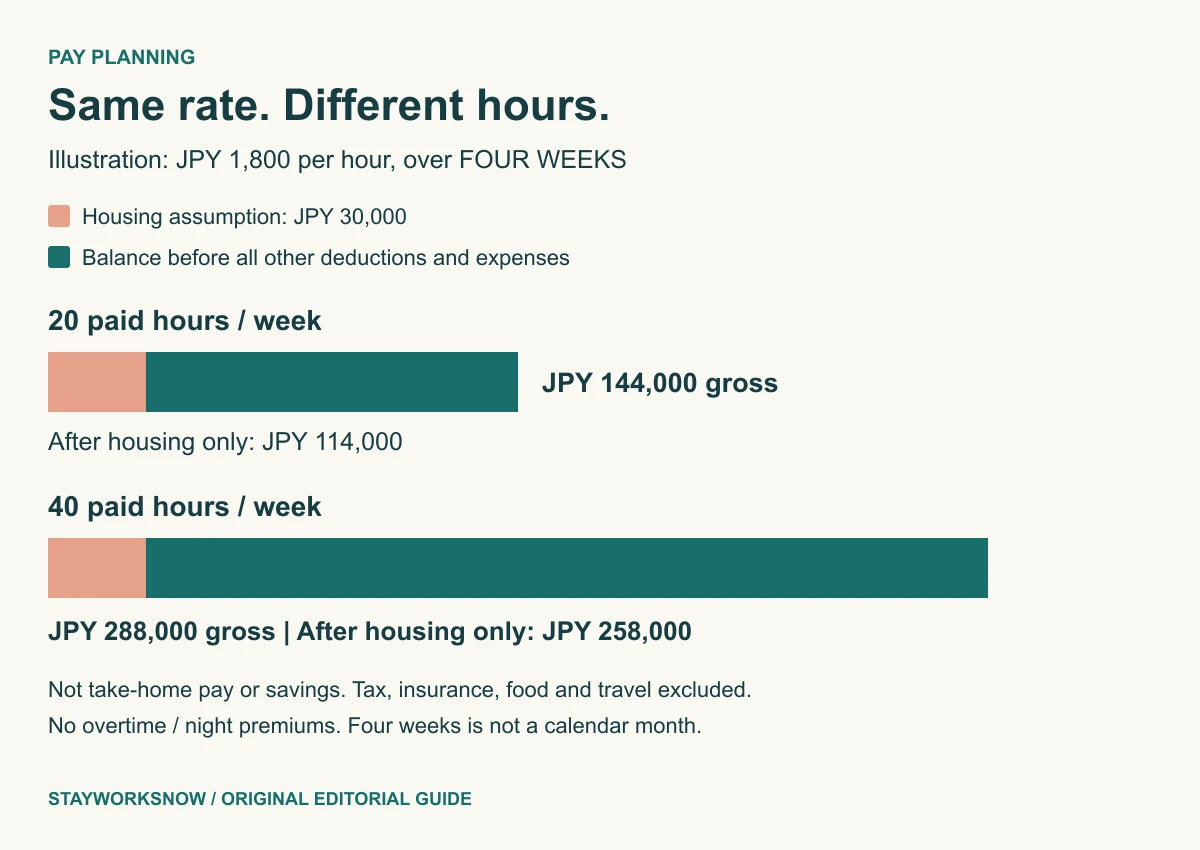
The bars use the same scale. Coral shows the assumed housing allocation; teal shows the balance before all other deductions and expenses. Editorial calculation, not an employer quotation.
Replace every assumption with your offer and expected expenses. Include arrival costs and the period before the first payday. Check heating, meals on days off, transport and any gap between leaving staff housing and entering your next home. If housing has already been deducted from the income figure you use, do not deduct it twice.
Leave unknown charges marked as unknown. An empty rent field is a question for the employer, not a reason to enter zero.
Work out the cash you need before your first payday
Monthly affordability and arrival cash are separate questions. A job may cover your usual expenses once pay begins while still requiring money that you do not have available on moving day. Ask for the payroll closing date and the first payment date, then work backwards from those dates.
The following is a fictional planning example for someone moving within Japan. These amounts are invented for the exercise, not surveyed prices or a recommended minimum balance.
| Expense due before the first payday | Example assumption |
|---|---|
| One-way travel and luggage | ¥15,000 |
| Existing apartment cost during the overlap | ¥30,000 |
| Staff-housing payment due in advance | ¥30,000 |
| Food and everyday spending until payday | ¥25,000 |
| Clothing or equipment you need to buy | ¥10,000 |
| Total planned payments | ¥110,000 |
| Separate emergency reserve | ¥30,000 |
| Cash available before moving in this example | ¥140,000 |
Replace the rows with the payment schedule in your own offer. If housing is deducted from later pay, remove it from advance payments and keep it in the relevant pay-period budget instead. If you keep your current apartment for longer, add the extra cost. Deposits, onward travel and other personal commitments may need separate rows.
Do not count a promised reimbursement as money you already hold. Ask whether travel support is paid before arrival, with a payslip or only after completing the contract. Record any conditions alongside the payment date. Keep the emergency reserve outside the amount you expect to spend on ordinary arrival costs.
Before you give notice on your current home, ask the new employer to confirm the room and move-in date in writing. An employment start date alone does not settle where you will sleep the night before your first shift.
Translate your language ability into real tasks
Recruiters need to understand what you can do at work. Instead of relying only on labels such as “basic Japanese” or “fluent English,” give an example of a task you can handle and an example where you would need support.
| Your situation | A useful way to explain it |
|---|---|
| Comfortable speaking English, learning Japanese | “I can welcome guests and explain bookings in English. I need support with Japanese phone calls.” |
| Stronger reading than speaking | “I can read routine instructions, but I would like to practise spoken handovers during training.” |
| Cleaning experience, new to hotel systems | “I have cleaning experience. I would need training on your room checklist and maintenance reporting.” |
| Customer service experience, new to the resort | “I can handle customer questions. I need local training before giving transport or activity advice.” |
These are sample descriptions, not job requirements. Use only statements that reflect your ability. Ask the employer which tasks must be done independently from the beginning and which will be taught.
You can prepare three short interview examples: a time you helped someone, a time you checked an unclear instruction and a time you reported a problem promptly. Everyday experience can be useful if you explain it accurately. Avoid describing a qualification, language level or driving permission you have not confirmed.
Conditions and workplace support matter to workers
A survey of 529 Okinawa tourism workers, conducted in October–November 2025 and published in January 2026, found that 75.0% rated workplace relationships as very important when choosing an industry or employer; 71.1% gave that rating to pay and bonuses. It was not a survey solely of foreign residents or seasonal workers. Okinawa Convention & Visitors Bureau.
An attractive location cannot tell you who will help during a difficult shift. Ask who trains new starters, which language is used in handovers and where you should go with a question. If you will work nights, discuss how the accommodation supports daytime sleep.
You cannot fully assess workplace relationships from an advertisement. Specific questions can still reveal more than a general description of a friendly team: who will work beside you in the first week, when would you be left alone, and what support is available then?
Questions to send before accepting an offer
| Topic | Question |
|---|---|
| Availability | I can work from [date] to [date]. Does that cover the required training and contract? |
| Language | Which languages are used for calls, guest service and internal reporting? |
| Duties | What would I do during my first month? |
| Work eligibility | Can you provide the duties and hours needed to check them against my own permissions? |
| Housing | What are the full charges, address and move-in and move-out dates? |
| Hours | Are weekly hours indicative or guaranteed, and what is expected in quieter periods? |
| Daily life | What transport and meal arrangements apply to early shifts, late shifts and days off? |
An employer welcoming foreign applicants does not determine your individual work eligibility. Obtain concrete duties and consult an appropriate official service when needed. This article does not make blanket eligibility judgments by residence status.
Keep the employer's answers beside the advertisement and written offer. If information changes, ask which terms apply to your contract. Our hotel staff housing guide and interview preparation article cover further questions you can use.
Use this sequence before committing to the move
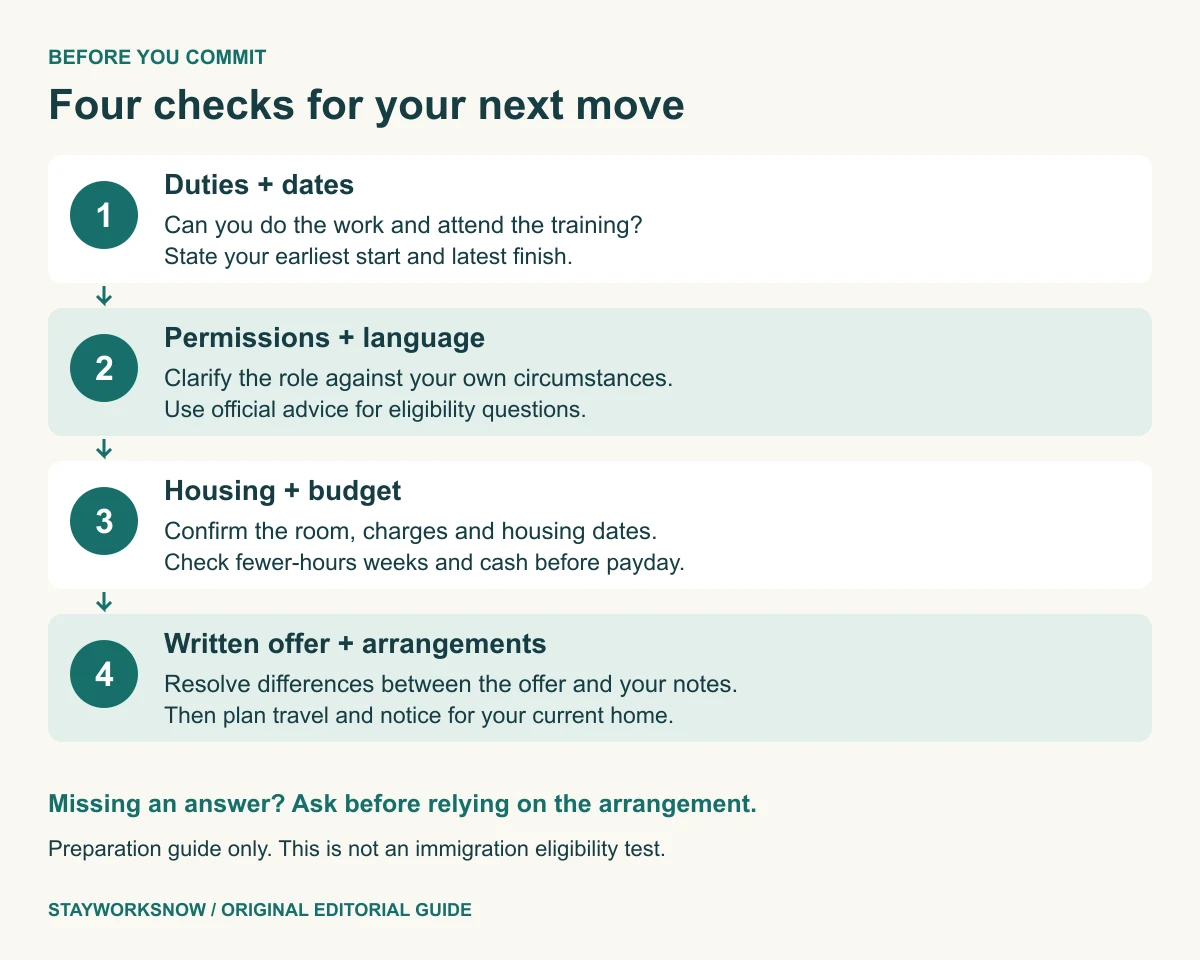
A preparation sequence, not an immigration eligibility test. A missing answer means you need clarification, not that a job is automatically unsuitable.
Keep one page for each offer. At the top, record the employer, role, workplace, vacancy URL and the date you checked it. Below that, record the latest written answer for pay, hours and housing. Mark information as “confirmed,” “estimated” or “waiting for an answer.” This prevents a friendly interview conversation from becoming an assumed contract term.
When comparing two roles, do not average away a condition you cannot meet. If you cannot arrive for mandatory training, a higher wage does not solve the date mismatch. If you need a private room, ask whether one is confirmed for you rather than treating a general accommodation benefit as sufficient.
Once the important details are clear, compare the written offer with your notes. If something differs, ask the employer to resolve it before you rely on the arrangement. For work-permission questions, take the actual duties and hours to an appropriate official service; this flowchart does not determine whether you can legally take a role.
A ready-to-adapt message for an employer
Subject: Winter 2026–27 role — availability and accommodation questions
Hello [name], I am interested in the [role] position. I currently live in [city] and can work from [start date] to [end date]. My relevant experience is [brief example], and I can work in [languages and practical level]. Before making arrangements to move, could you confirm the training dates, expected paid hours and whether there is a guaranteed minimum? I would also like to know the accommodation charges, move-in and move-out dates, and transport for early and late shifts. Please could you share the main duties and written employment conditions so I can check them against my circumstances? If a condition is still undecided, please let me know when it is expected to be confirmed. Thank you, [name]
Adapt the message to what is missing from the listing. If the employer has already provided a clear answer, avoid asking again without a reason. A short, specific request makes it easier for both sides to identify whether the arrangement works.
Plan the end of the season while choosing the beginning
Put four dates on one line: your last shift, your last permitted night in staff housing, your final payday and the date you can enter your next home. They may not coincide. Ask about each one before treating the season as a complete financial plan.
If you want to stay with the employer longer, ask when an extension decision will be made and whether accommodation would continue. Keep a second plan until there is a confirmed arrangement. That might mean returning to your current city, keeping cash for temporary accommodation or allowing time between contracts.
Keep your own copies of the agreed conditions and payment records. At the end of the contract, you can compare the final payment and any housing charges with what was agreed. You can also ask whether the employer can provide a record of your role or a reference, rather than assuming one will be available automatically.
This end-of-season plan helps you compare a short resort role with longer employment. A good month of earnings is useful, but the weeks between jobs belong in the same decision.
Prepare your conditions, then take the next step
Resort employment in 2026 has both current recruitment examples and evidence of people taking work. Your task is to find the arrangement that fits your dates, skills and living budget.
StayWorksNow publishes practical information for people considering hotel work in Japan. When you are ready, create a free account. Registration does not automatically start job applications or job notifications.
Frequently asked questions
Does a labour shortage mean beginners will be accepted?
It depends on the position. Check whether experience is required, how training works and which tasks you would perform alone. A sector-wide survey cannot supply an individual hiring probability.
Is the region with the most advertisements the best choice?
Count the offers that fit your dates, duties and housing needs. Raw listing counts may include duplicate advertisements or roles you cannot accept. A smaller set of suitable offers is more useful for making a decision.
Should I prioritize higher pay or cheaper housing?
Compare paid hours and total expenses under the same assumptions. A higher hourly rate may come with fewer hours, while inexpensive housing may have separate heating or transport costs. Resolve missing terms before choosing.
Primary sources
Sources checked: . Official source pages may be in Japanese.
YOUR NEXT STEP
Thinking about hotel work? Start with a free account.
StayWorksNow is accepting early member registrations. Register with your email address, then view your membership information in My Page.
- Free registration
- No CV or phone number needed
- No password needed
- Enter your email address
- Open the confirmation email
- Confirm to finish registration
Job applications and job alerts are not available yet. Registering does not apply for a job or share your details with hotels. The registration page is currently in Japanese.
Already registered? Go to My Page