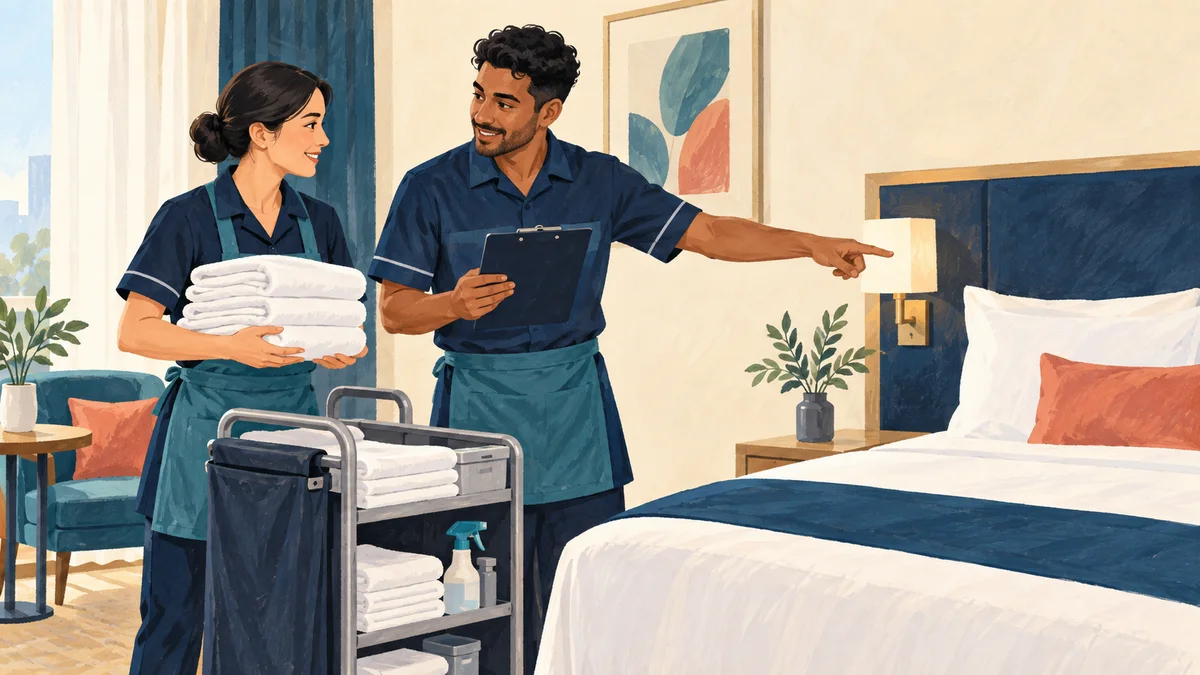
In shortHotel housekeeping job requirements in Japan depend on the actual tasks, the employer's training and language needs, and your permission to work. There is no reliable nationwide answer such as “no Japanese needed,” “every foreign resident can apply,” or “all hotels require experience.” A useful job description should explain what you clean, how the shift works, and who helps you learn the standard.
Quick guide
| Check | What to know |
|---|---|
| Before you begin | For foreign residents comparing roles in 2026, the most important distinction is between being able to perform the job and being authorised to do it. You need to consider both. This guide provides a task checklist, practice phrases, and a comparison worksheet so you can ask specific questions before committing. |
| What does a hotel housekeeper actually do? | Room cleaning involves more than making the bed. Depending on the employer's organisation, you may prepare a complete guest room or handle one stage while colleagues do the others. A team arrangement can feel different from working alone even when the advertisement gives the same room count. |
| What changed in the 2026 official guidance? | MHLW's 13 July 2026 Q&A confirms that a complete sequence of hotel guest-room cleaning, including amenities and bed making, is main work in the SSW building cleaning field. This does not mean every standalone bed-making assignment or every worker's permission is automatically covered. MHLW Q&A, question 6. |
| Requirement 1: permission for the specific work | Read your current residence status, work restriction, and any separate permission or designation. A role advertised to foreigners is not evidence that your own permission covers it. The related StayWorksNow residence-status guide explains how to prepare a task description for an official inquiry. |
| Requirement 2: enough Japanese for the actual workflow | A room-cleaning role may involve less guest conversation than reception, but communication remains part of the work. You may need to distinguish a room ready for cleaning from one that must not be entered, understand a changed assignment, and report a problem without guessing. |
| Requirement 3: training suited to your starting point | If the advertisement welcomes beginners, ask what the first week looks like. Will you observe, practise individual tasks, and then prepare a full room? Who checks the result? How does the employer decide that you are ready to work independently? |
| Requirement 4: a workload you can understand | “How many rooms per day?” is a useful opening question, but it is incomplete. Ask whether the number refers to complete rooms, beds, assigned sections, or team output. Check the room type, stayover versus checkout cleaning, time spent moving supplies, and whether inspection and rework are included. |
| Requirement 5: equipment and a clear safety process | Discuss the movements involved: reaching across beds, bending for bathrooms, pushing carts, and transporting linen. Ask whether a demonstration or workplace visit can show the setup. Describe any practical concern accurately rather than promising you can lift anything or work at any speed. |
| Compare pay and shifts using the same assumptions | Do not compare only the largest yen amount in an advertisement. Record whether the figure is hourly or monthly, what hours it assumes, and whether allowances are conditional. Ask about training pay, the payday, transport costs, uniforms, and any accommodation charges before deciding what the role would mean for your budget. |
| A comparison sheet for two employers | Download the StayWorksNow housekeeping requirements worksheet. It is an original editorial tool. An empty answer means “not yet confirmed,” not “no problem.” |
| Questions you can use at the interview | Choose the questions that remain unresolved; you do not need to read every question aloud. |
| Decide with the task list in front of you | A suitable role should be understandable before your first shift: what you do, who teaches you, how the work is checked, and what conditions apply. Keep the worksheet and return to any unanswered item before accepting the proposed start date. |
Before you begin
For foreign residents comparing roles in 2026, the most important distinction is between being able to perform the job and being authorised to do it. You need to consider both. This guide provides a task checklist, practice phrases, and a comparison worksheet so you can ask specific questions before committing.
Updated 19 September 2026. Immigration statements use official sources. All sample questions, calculations, and scenarios are StayWorksNow editorial examples. They are not a survey of hotels or accounts from interviewed workers.
What does a hotel housekeeper actually do?
Room cleaning involves more than making the bed. Depending on the employer's organisation, you may prepare a complete guest room or handle one stage while colleagues do the others. A team arrangement can feel different from working alone even when the advertisement gives the same room count.
Use this task map during an interview. The right-hand column describes information to obtain, not a promise about what every hotel provides.
| Part of the job | What the task might include | Ask the employer |
|---|---|---|
| Receiving the assignment | Reading room numbers and cleaning status | How do I confirm which rooms I may enter? |
| Preparing the room | Removing used linen and rubbish | Which items must be reported rather than discarded? |
| Beds | Changing sheets and pillowcases; arranging bedding | Do I work alone or with another person? |
| Bathroom | Cleaning the bath, toilet, basin, and surfaces | How are products and tools identified? |
| Room surfaces | Floors, mirrors, furniture, and touch points | Is there a visual checklist for the required standard? |
| Supplies | Replacing towels and amenities | Where do I record a shortage or damaged item? |
| Final check | Inspecting the room and reporting completion | Who checks my work during and after training? |
Ask separately about common areas, breakfast spaces, laundry, and moving supplies between floors. Those duties change both the workload and the description you may need for a residence-status inquiry. Do not let the word “housekeeping” hide the actual range of work.
What changed in the 2026 official guidance?
MHLW's 13 July 2026 Q&A confirms that a complete sequence of hotel guest-room cleaning, including amenities and bed making, is main work in the SSW building cleaning field. This does not mean every standalone bed-making assignment or every worker's permission is automatically covered. MHLW Q&A, question 6.
The ministry's framework page also links the building cleaning operational guidelines amended on 28 August 2026. For an SSW role, ask the employer to use the current documents when explaining its proposed arrangement, rather than relying on an undated recruitment graphic. MHLW: current building cleaning framework, operational guidelines.
For applicants, the practical lesson is to obtain a full task list. “Bed making” might be used casually to describe complete room preparation or literally to mean one isolated task. Make the employer explain which it means before using that description in any official inquiry.
Requirement 1: permission for the specific work
Read your current residence status, work restriction, and any separate permission or designation. A role advertised to foreigners is not evidence that your own permission covers it. The related StayWorksNow residence-status guide explains how to prepare a task description for an official inquiry.
If the proposed route is SSW (i), building cleaning, the official support site lists the field skills evaluation test and JFT-Basic or JLPT N4 or higher, with specified Technical Intern Training exemptions. These are part of the route; passing tests does not itself grant permission to start a job. ISA: SSW (i), building cleaning.
Do not use those SSW requirements as a universal checklist for every applicant. A person whose existing permission has no restriction on work activities has a different starting point. A student needs to examine separate permission and hours. A person with another work status needs to check how the actual cleaning duties relate to it.
Ask who your legal employer will be: the hotel, a cleaning company, or another organisation. Record that name alongside the hotel brand. For building cleaning SSW, employer-side conditions matter too; you should not be expected to resolve an unclear arrangement simply by producing a language certificate.
Requirement 2: enough Japanese for the actual workflow
A room-cleaning role may involve less guest conversation than reception, but communication remains part of the work. You may need to distinguish a room ready for cleaning from one that must not be entered, understand a changed assignment, and report a problem without guessing.
A helpful employer can describe the communication method rather than only saying “basic Japanese.” Ask whether instructions are spoken, written, shown in photographs, or displayed in an application. Check which language the supervisor uses and how you can request a demonstration.
These phrases are editorial practice examples. Learn the hotel's own terms and reporting process during training.
| Situation | Japanese practice phrase | Meaning |
|---|---|---|
| Confirming a room | 305号室でよろしいですか。 | Is room 305 correct? |
| Asking for a demonstration | もう一度見せていただけますか。 | Could you show me once more? |
| Reporting an item | 忘れ物がありました。 | I found an item left behind. |
| Reporting damage | 鏡にひびがあります。 | There is a crack in the mirror. |
| Asking about a product | この洗剤はどこに使いますか。 | Where should I use this cleaning product? |
| Requesting help | 一人で運ぶのは難しいです。手伝っていただけますか。 | This is difficult to move alone. Could you help? |
You do not need to pretend that you understand an unfamiliar instruction. A strong interview answer can be: “I repeat the room number and ask for a demonstration when I am unsure.” That explains a safe communication habit more clearly than simply claiming “conversational Japanese.”
Requirement 3: training suited to your starting point
If the advertisement welcomes beginners, ask what the first week looks like. Will you observe, practise individual tasks, and then prepare a full room? Who checks the result? How does the employer decide that you are ready to work independently?
A useful answer includes a named role responsible for training, a way to ask questions, and clear expectations. “Someone will show you” leaves uncertainty about what happens when the team is busy. Ask whether the person training you is on the same shift and whether you receive feedback in a language or format you understand.
You can bring experience from other work without inventing hotel experience. For example, describe how you followed a stock checklist, reported a damaged item, or kept separate tools for different tasks. Explain what you did and what you still need to learn. Avoid claiming that cleaning your own home is identical to preparing rooms to a hotel's standard.
Keep a short learning log during training: task, instruction, point to practise, and person to ask. It can make repeated questions more precise. Do not photograph guests' belongings or hotel records for your notes; ask what training materials you are allowed to keep.
Requirement 4: a workload you can understand
“How many rooms per day?” is a useful opening question, but it is incomplete. Ask whether the number refers to complete rooms, beds, assigned sections, or team output. Check the room type, stayover versus checkout cleaning, time spent moving supplies, and whether inspection and rework are included.
Here is a fictional calculation to show why the details matter:
- A scheduled period contains 300 minutes available for work after a separately stated break.
- The employer allocates 45 minutes to a briefing, moving supplies, and end-of-shift tasks.
- That leaves 255 minutes for room tasks and related checks.
- At 12 assigned rooms, the arithmetic is 21.25 minutes per room.
This is not a recommended target, an industry average, or proof that the workload is reasonable. It is a prompt to ask what the remaining time must cover. A large room, a difficult clean, or a changed assignment can make a simple average misleading.
Ask for training-stage and experienced-worker expectations separately. Also ask what happens if a guest checks out late or a room needs extra attention. The key question is not whether the advertisement has an impressive number; it is whether the employer explains how quality, support, and time fit together.
Requirement 5: equipment and a clear safety process
Discuss the movements involved: reaching across beds, bending for bathrooms, pushing carts, and transporting linen. Ask whether a demonstration or workplace visit can show the setup. Describe any practical concern accurately rather than promising you can lift anything or work at any speed.
Useful questions include: “Which gloves and footwear are provided?”, “Who explains the labels?”, and “What should I do if I find broken glass or an unknown substance?” Ask how to report discomfort or equipment problems before continuing. Training should make it clear whom you contact and which tasks you pause while waiting for help.
Treat photographs of a tidy hotel room as marketing, not evidence of the working setup. The size of the linen cart, storage location, and availability of a supervisor can matter more to your day than the lobby design. Your comparison notes should include these practical details.
Compare pay and shifts using the same assumptions
Do not compare only the largest yen amount in an advertisement. Record whether the figure is hourly or monthly, what hours it assumes, and whether allowances are conditional. Ask about training pay, the payday, transport costs, uniforms, and any accommodation charges before deciding what the role would mean for your budget.
If payment is described per room or per task, ask how all working time is recorded, how training and rework are handled, and how the arrangement complies with applicable wage rules. This article does not present a room rate as an hourly wage or publish an unsupported national salary range.
Check the practical schedule too. A five-hour shift may fit your day differently depending on travel time, the first train, and how often finishing time changes. Ask whether the published hours describe the usual pattern or a guaranteed arrangement, and get the proposed terms in writing.
For students, the official Study in Japan guidance describes outside-activity permission and the general 28-hour weekly limit, with a separate long-school-holiday provision. Use your own permission and total schedule across jobs when discussing shifts. JASSO: part-time work.
A comparison sheet for two employers
Download the StayWorksNow housekeeping requirements worksheet. It is an original editorial tool. An empty answer means “not yet confirmed,” not “no problem.”
| Topic | A useful answer contains |
|---|---|
| Employer and site | Company name, hotel location, expected transfers |
| Task scope | Complete room or divided tasks; additional duties |
| Room expectations | Definition of one room, training target, busy-day process |
| Language support | Instruction format, supervisor, reporting method |
| Training | Who teaches, how work is checked, next-stage criteria |
| Pay and hours | Basis of pay, recorded time, breaks, typical finish |
| Equipment | Supplied items, movement of linen, help with difficult tasks |
| Work permission | Route or existing permission to confirm; responsible contact |
After the interview, mark each answer as written, spoken, or still unknown. This simple distinction prevents a vague reassurance from becoming a remembered promise. Where two employers use different definitions, ask a follow-up before comparing the numbers.
Questions you can use at the interview
Choose the questions that remain unresolved; you do not need to read every question aloud.
1. “Could you describe the tasks in one normal shift?”
2. “Do beginners clean a complete room or learn one task at a time?”
3. “What does the room-count target include?”
4. “Who checks my work and helps when I do not understand?”
5. “How do I report a lost item, damage, or a safety concern?”
6. “What happens if the assigned rooms take longer than expected?”
7. “Which company will be named on my contract?”
8. “Can I receive the duties, hours, and pay conditions in writing?”
A clear answer matters more than an enthusiastic answer. If the person interviewing you does not know, ask who can confirm and when. You can remain interested in a role while leaving an important point open.
Decide with the task list in front of you
A suitable role should be understandable before your first shift: what you do, who teaches you, how the work is checked, and what conditions apply. Keep the worksheet and return to any unanswered item before accepting the proposed start date.
You can create a free StayWorksNow account as you prepare for hotel work in Japan. Registration is not a job application, immigration approval, or employment guarantee. Use the guides and your own notes to make a more informed next step.
Frequently asked questions
Can foreigners get hotel housekeeping jobs in Japan without experience?
Some employers may train beginners, but the specific opening must say what experience it expects. Ask about supervised practice and the training-stage workload. Work eligibility remains a separate check.
Can I work in housekeeping without Japanese?
Requirements differ. Ask how you will understand assignments, safety instructions, and reports. “No customer conversation” does not necessarily mean no Japanese is used at work.
Is hotel housekeeping covered by the accommodation SSW field?
Do not decide from the hotel location alone. For a role centred on complete room cleaning, check building cleaning and the exact duties. The relevant field and permission must be confirmed for the actual arrangement.
How many rooms should a beginner clean?
There is no universal figure established in this guide. Room size, task division, cleaning type, equipment, and training stage all affect the comparison. Request the employer's own expectations and support process.
Is a short unpaid trial enough to decide whether I like the job?
First establish what the trial involves, whether it is work, what terms apply, and whether your permission covers it. Do not treat the label “trial” as an answer to pay or immigration questions.
Primary sources and further reading
Sources checked: . Official source pages may be in Japanese.
YOUR NEXT STEP
Thinking about hotel work? Start with a free account.
StayWorksNow is accepting early member registrations. Register with your email address, then view your membership information in My Page.
- Free registration
- No CV or phone number needed
- No password needed
- Enter your email address
- Open the confirmation email
- Confirm to finish registration
Job applications and job alerts are not available yet. Registering does not apply for a job or share your details with hotels. The registration page is currently in Japanese.
Already registered? Go to My Page